
Free Printable Multiplication Chart 1-20
Print a free multiplication chart 1-20, the 20x20 times table chart with every product up to 400, from the ready-made charts below or as a PDF. Customize your own with any tables blank and an answer key.
Ready-made 1-20 multiplication charts
-
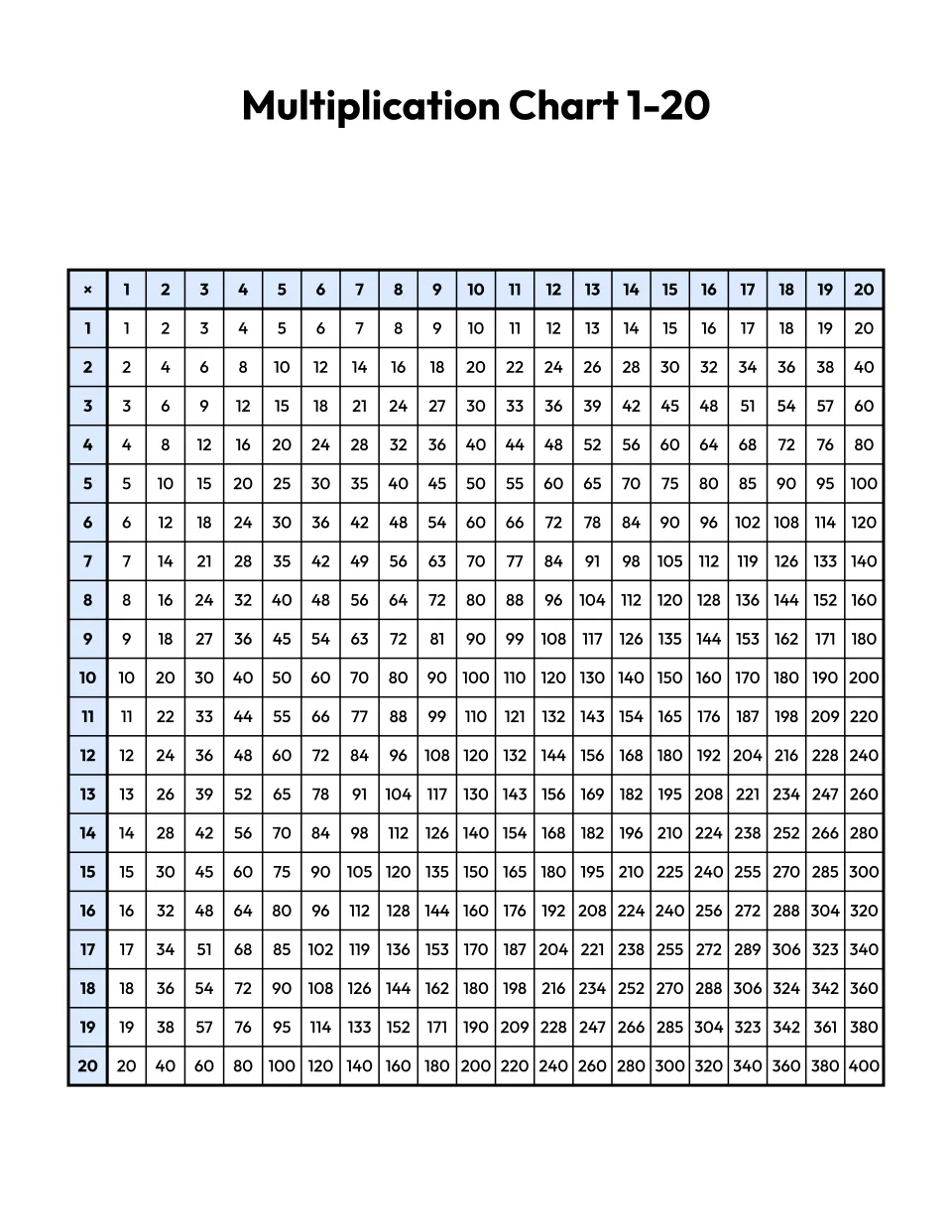
1-20
Customize the multiplication chart 1-20, filled in -
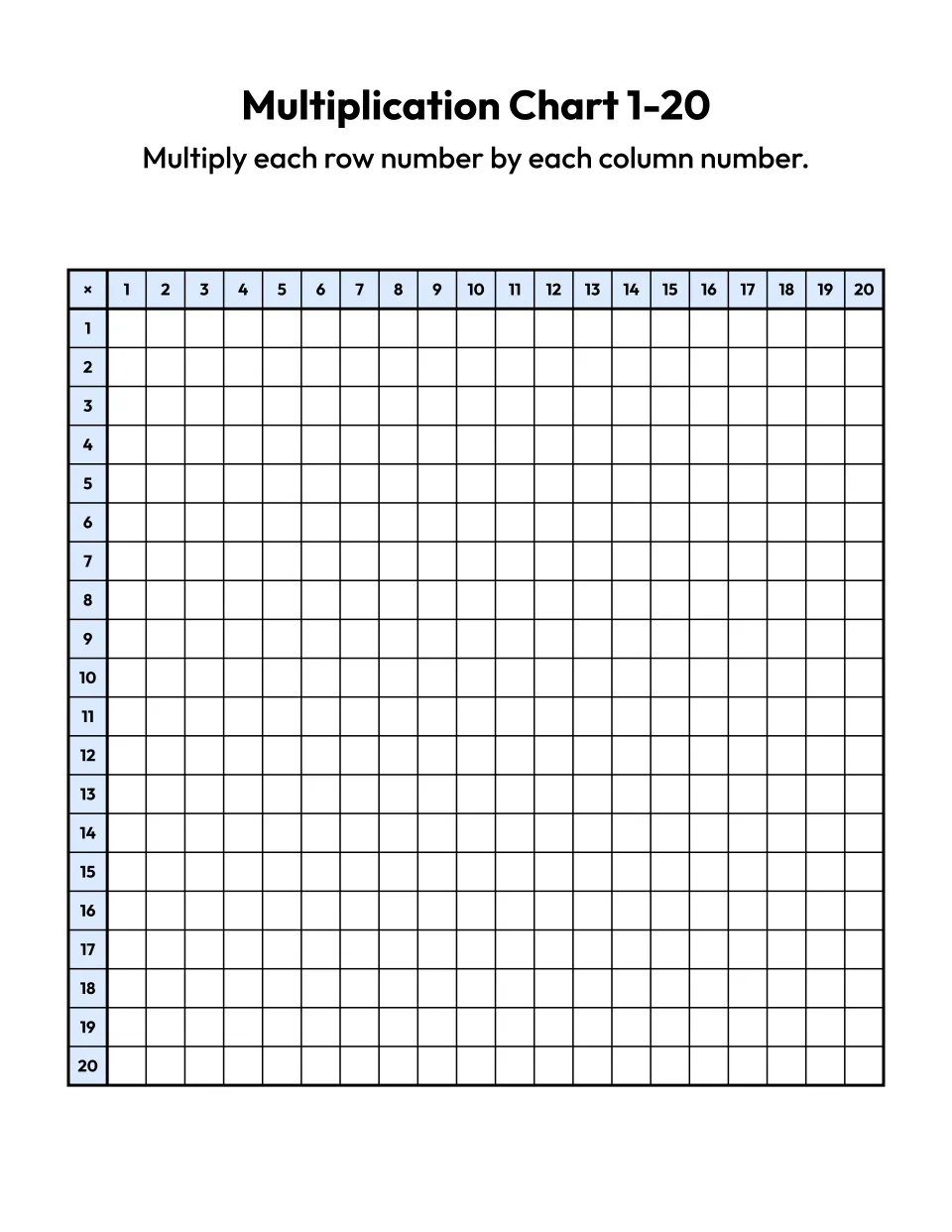
Blank 1-20
Customize the blank multiplication chart 1-20 -
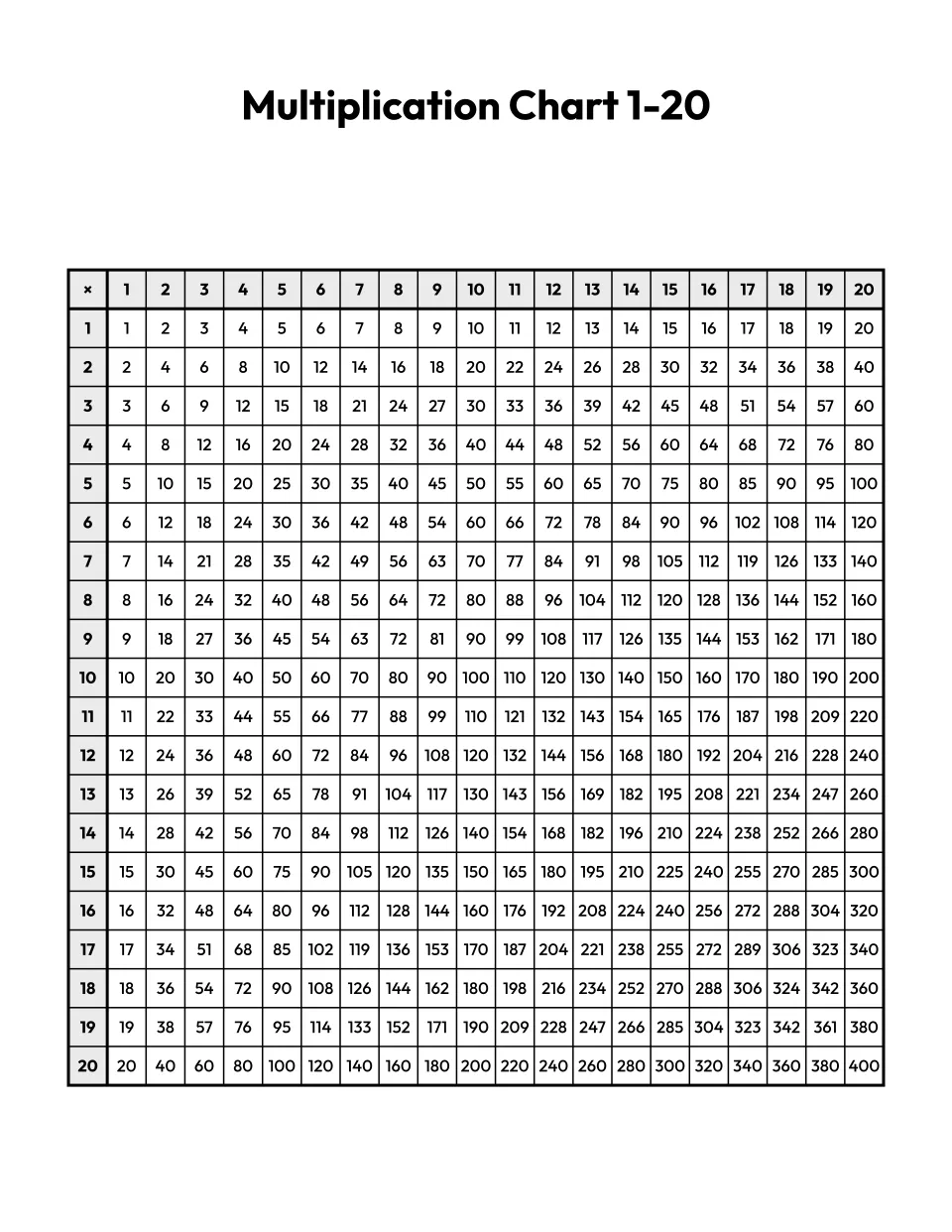
Black and white 1-20
Customize the black and white multiplication chart 1-20 -
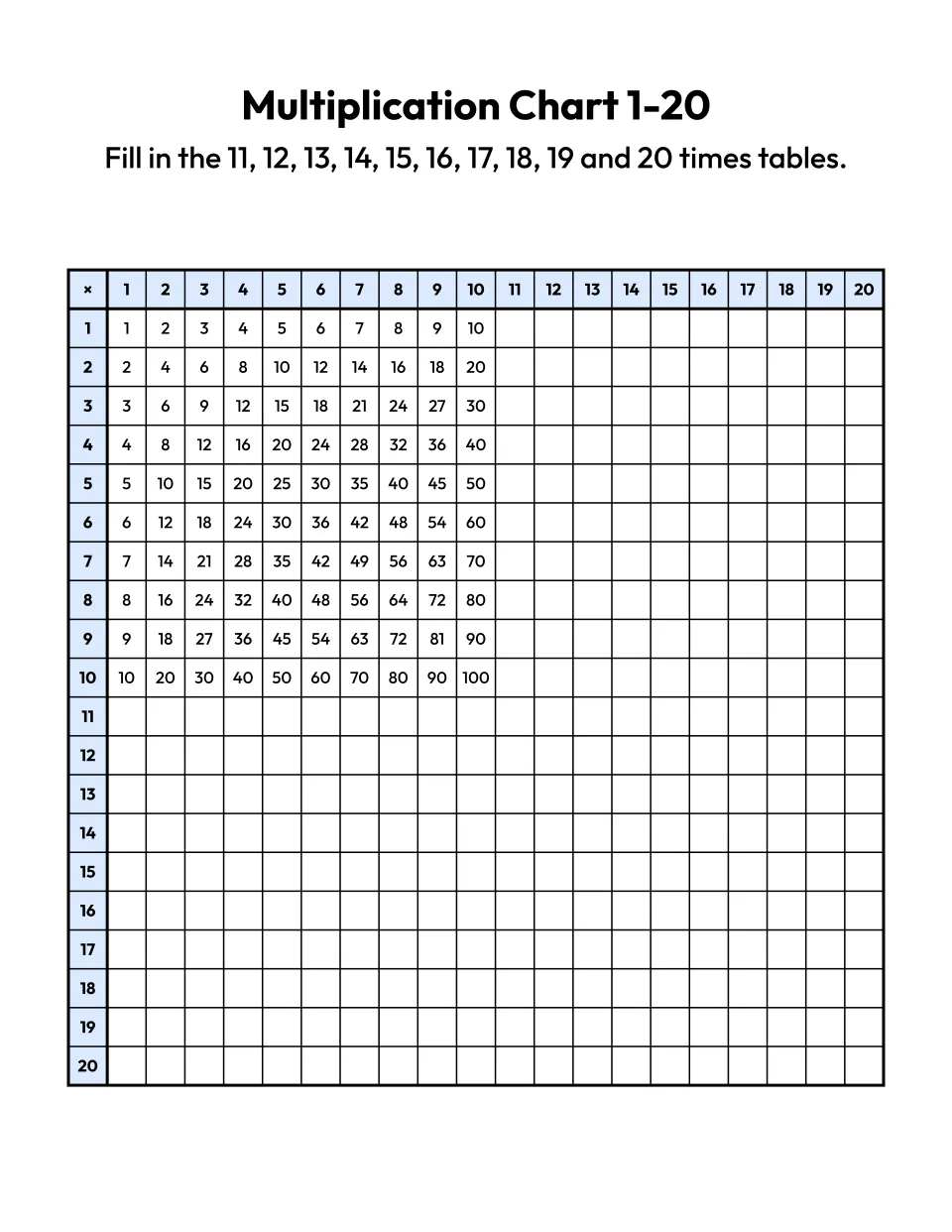
11-20 to fill in
Customize the multiplication chart 1-20 with the 11 to 20 tables blank
How to learn the times tables to 20
Learn the tables to 10 first: they fill the top left corner of a 1-20 chart. Each teen fact splits into two a child knows: 13 × 7 is 10 × 7 plus 3 × 7, or 70 + 21 = 91. The 20s are the 2s with a zero on the end, so 20 × 6 = 120.
Customize your own
What is a 1-20 multiplication chart?
A 1-20 multiplication chart, also called a 20x20 multiplication chart, lists the numbers 1 to 20 along the top and down the left side. Its 400 product squares end at 20 × 20 = 400. England’s national curriculum covers tables up to 12 × 12 by Year 4, so the 13s to 20s are extra practice for children who know those facts.
How to make your own 1-20 multiplication chart
Under Customize your own, the chart opens on Times tables up to 20. Choose what the cells show, or click squares on the chart to leave them blank, and a number in the top row or left column to blank its whole table. Pick Highlight square numbers, Color or Black and white, and the paper, then press Print or PDF.
Choosing settings
A child who knows the tables to 12 can lean on those rows and work on the rest. Chosen tables blank empties a table’s row and column, so the 13s leave 39 squares to fill in, and the 11 to 20 chart above leaves 300. Some blank leaves 100, 200 or 300 of the 400 product squares blank, and Shuffle squares picks a fresh set.
| Stage | Cells | Tables to fill in |
|---|---|---|
| Reading the chart | All products | Not used |
| Learning the 13s to 15s | Chosen tables blank | 13, 14, 15 |
| Learning the 16s to 20s | Chosen tables blank | 16, 17, 18, 19, 20 |
| Review | Some blank, 25% | Not used |
What you get
Each chart fills one portrait page on US Letter or A4, with squares about 7.5 mm across and digits just over 2 mm tall. For bigger squares, change Times tables up to 15 or 12. The header row and column print pale blue in color and light grey in black and white. When any square is blank, page 2 of the PDF and of Print is the answer key, with the written-in products in bold. PNG saves the chart only. For a class, Add a version makes up to six charts, lettered A to F, each with settings of its own, such as the 13s blank for one group and the 16s to 20s for another.
Tips for a 1-20 chart
- Add one table a week. Tick 13 under Tables to fill in, then 13 and 14 the week after.
- Step from a 10. 16 × 10 is 160, so 16 × 9 is 160 − 16 = 144.
- Learn the squares to 400. Highlight square numbers shades the 20 squares on the diagonal, from 1 up to 400.
- Halve the work. 14 × 17 and 17 × 14 are both 238, so a child can fill the squares below the diagonal and copy each answer across.
More math printables
For a 1-12, 1-10 or 1-15 chart, print the free printable multiplication chart. Younger children can start with a printable 100 chart. For number puzzles, try sudoku for kids, or print graph paper for working out long multiplication. For practice on the tables from 1 to 12, print multiplication color by number worksheets with a problem to solve in each space of a picture. Every maker is on our free printable makers page.
Questions about the 1-20 multiplication chart
Is the 1-20 multiplication chart free?
Yes. Every chart on this page is free, including the blank and 11 to 20 charts, and there is no sign up or limit on how many you print. Each chart is drawn in your browser, so nothing you type is uploaded. The charts are free for personal and classroom use, so print as many copies as your class or homeschool group needs.
Does the 1-20 chart have an answer key?
Yes, whenever a square is blank. The blank and 11 to 20 charts above, and any chart you make with Some blank, Chosen tables blank, Hand-picked or Blank, put the answer key on page 2 of the PDF, and Print prints both pages. The key is the full chart with the written-in products in bold. A chart with all 400 products needs no key.
Is a 20x20 multiplication chart the same as a 1-20 chart?
Yes. A 20 × 20, 20x20 or 20 by 20 multiplication chart and a multiplication chart up to 20 all name the same grid: the numbers 1 to 20 across the top and down the side, and 400 products from 1 × 1 to 20 × 20. With its header row and column, the printed grid is 21 squares wide and 21 squares tall.
Why does the chart stop at 20?
Twenty is the largest chart that fits one portrait page with digits you can still read, just over 2 mm tall. A 1 to 25 or 1 to 30 chart on one page would print digits too small to read, and a 1 to 100 chart takes several pages. Some sites call an ordinary 1 to 10 chart a “1-100 chart”, since its products run to 100. To make one, set Times tables up to 10.
How do you use a 1-20 chart for division?
Go along the row of the number you divide by to the number being divided, then look up to the top of that column. For 221 ÷ 13, follow row 13 to 221 and look up to 17. A greenhouse with 221 seedlings in rows of 13 has 17 rows. The chart shows only divisions that come out even, up to 400 ÷ 20.
Can I save or share my chart?
Yes. After you change any setting under Customize your own, the page address carries every version with its size, cells, tables, highlight, colors and the squares you picked, so a bookmark or a link sent to another teacher opens the same charts. With Some blank, the same squares stay blank each time the link opens, and Shuffle squares picks a different set.
Can I print the 1-20 chart on A4 or from a phone?
Yes. Tap PDF under any chart to save it to your phone or tablet, or Print to send it to a wireless printer. If your printer takes A4, choose A4 under Paper in Customize your own, and both the ready-made charts and your own print on A4 instead of US Letter. Print the PDF at 100% scale so the digits stay just over 2 mm tall.