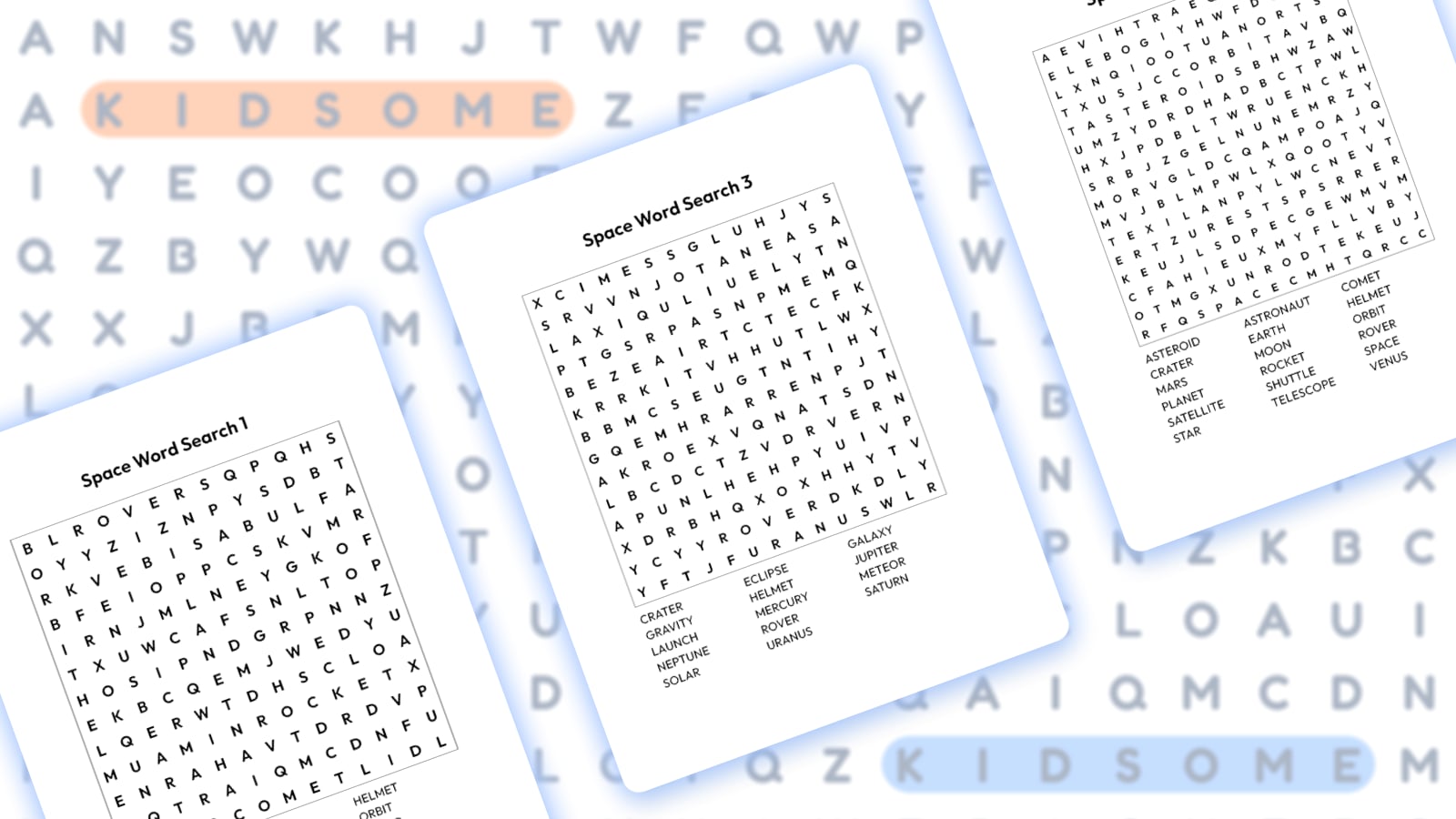
This space word search set has six puzzles for kids who want to know what lies past the Moon, and each one is a little harder than the one before. Easy Star and Moon Search starts with a 13 by 13 grid and twelve words, such as star, moon, rocket and rover, that run only across or down. By the last page the grid is 16 by 16, with eighteen words hiding forward, backward, up, down and on the slant.
The word lists read like a solar system unit: all eight planets from Mercury to Neptune, plus comet, crater, orbit, gravity, eclipse and galaxy, and long words such as astronaut, telescope and satellite. Every puzzle is a free PDF with its answer key on page two, so checking a finished sheet takes a few seconds. The PDFs print on US Letter and A4 paper, and there is no sign-up.
The set suits ages 8 to 12 and the third to fifth grade classrooms that study space. Newer searchers can start on the first two pages, while puzzle fans can jump ahead to the backward and diagonal grids. For other themes, browse all the word search puzzles on the site.
Download the space word search puzzles
 Save
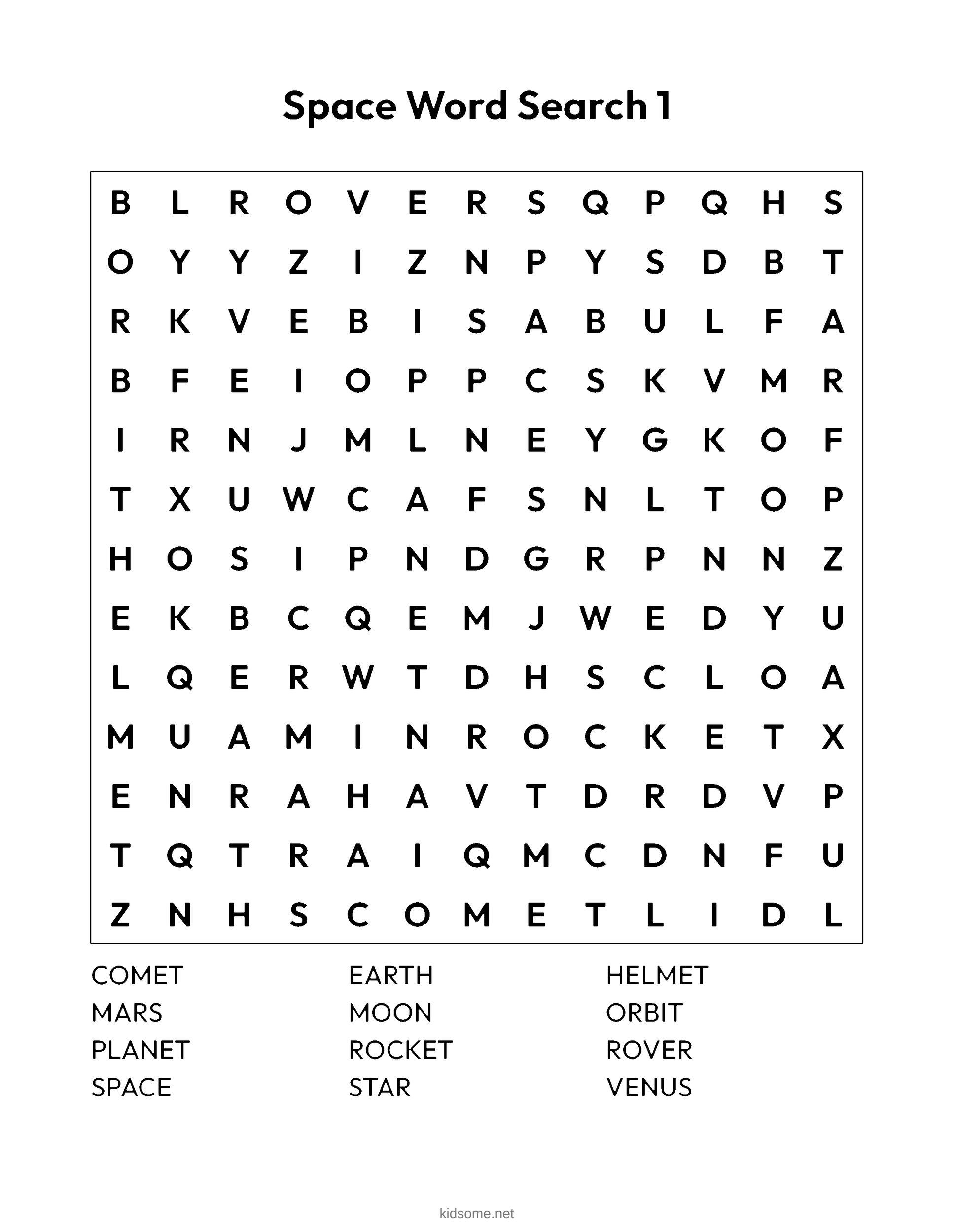
Easy Star and Moon Search
A 13 by 13 grid with twelve words, including star, moon, rocket, rover and Mars, that run only across or down, the easiest page to start the set on.
Download PDFWord List: COMET, EARTH, HELMET, MARS, MOON, ORBIT, PLANET, ROCKET, ROVER, SPACE, STAR, VENUS
Reveal Word List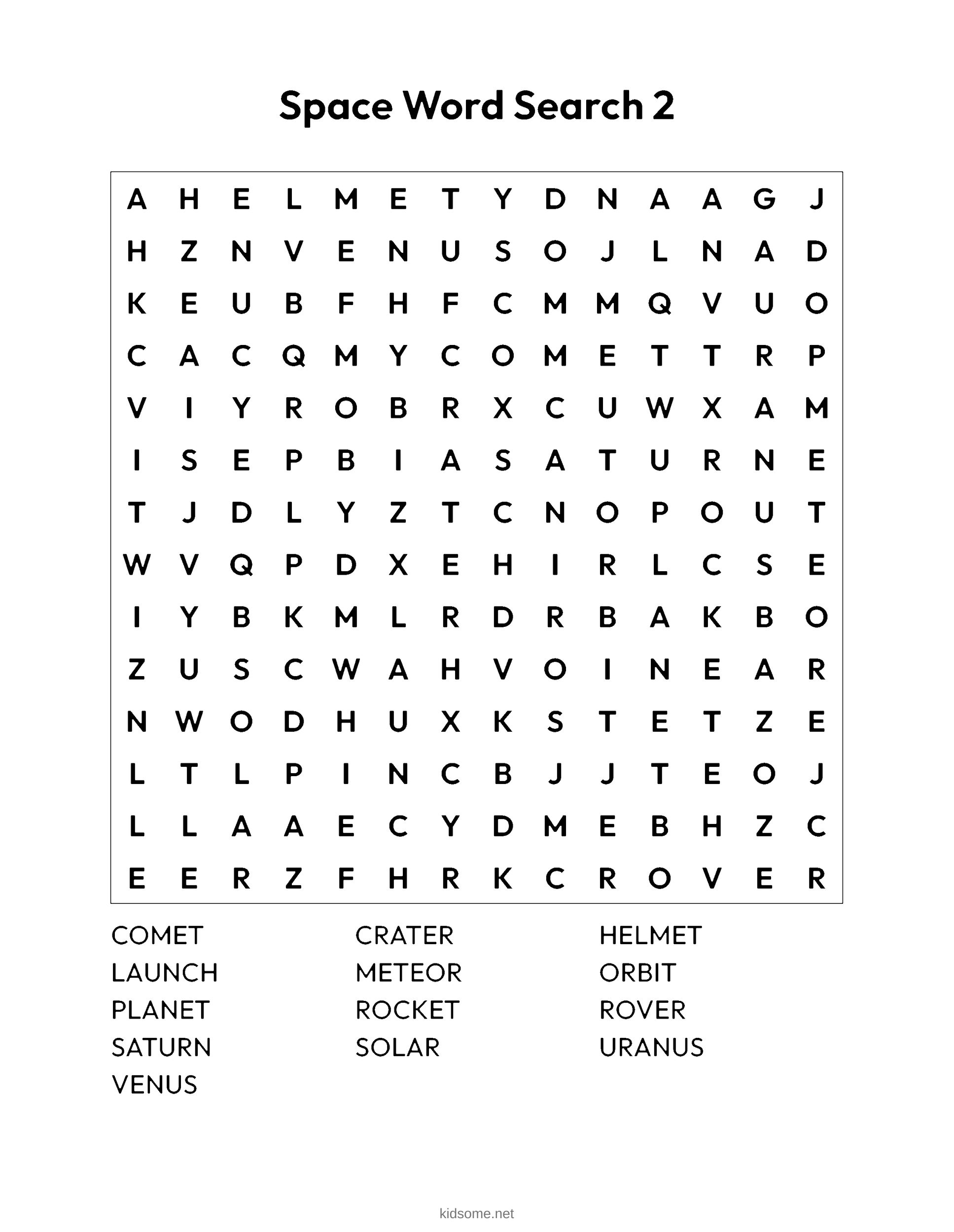 Save
Comet and Crater Search
A 14 by 14 grid with thirteen words such as comet, crater, Saturn, Uranus and launch, still running only across or down, with a few words crossing at a shared letter.
Download PDFWord List: COMET, CRATER, HELMET, LAUNCH, METEOR, ORBIT, PLANET, ROCKET, ROVER, SATURN, SOLAR, URANUS, VENUS
Reveal Word List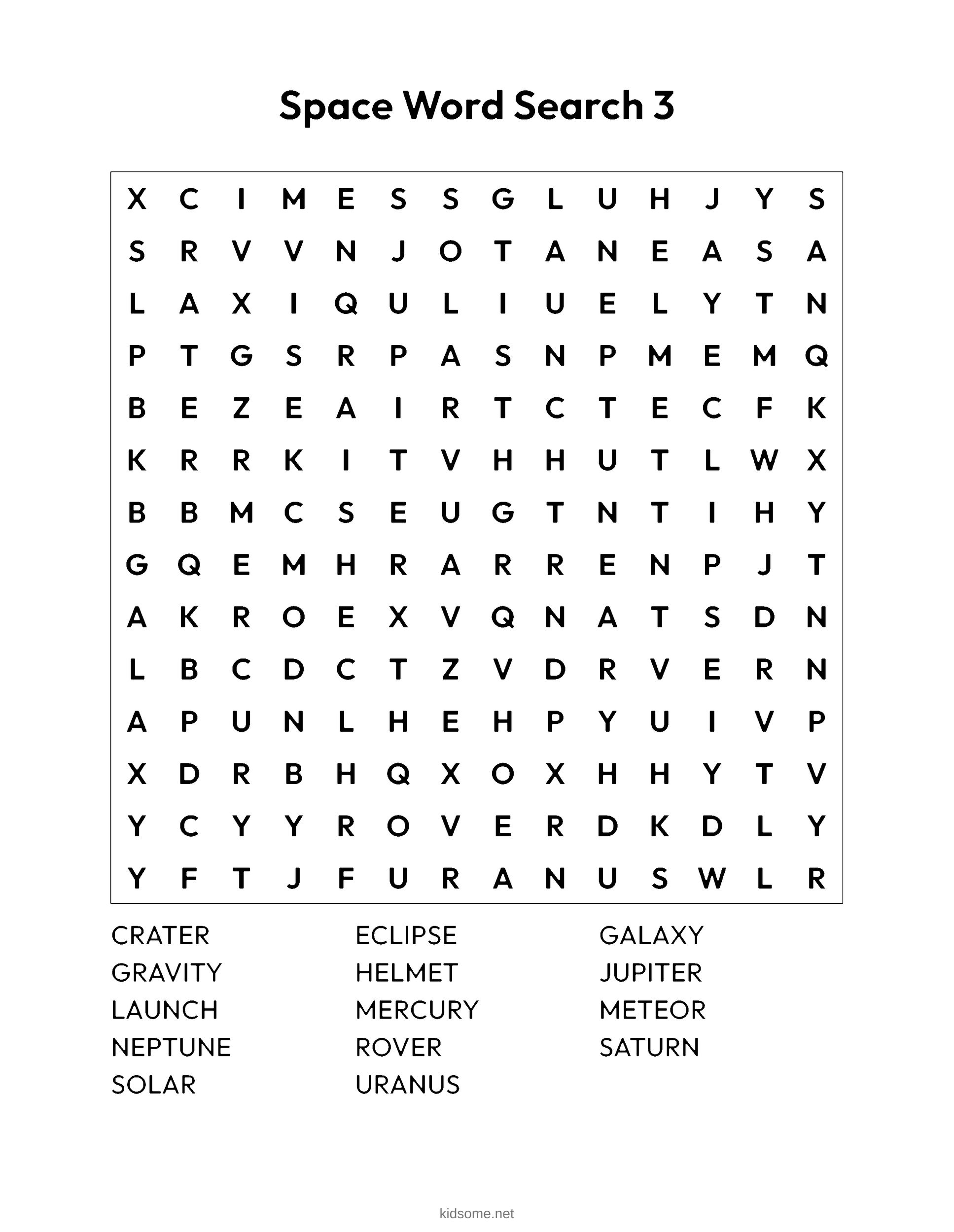 Save
Gravity and Meteor Diagonal Search
A 14 by 14 grid with fourteen words, five of them planets, where gravity, meteor and Saturn slant on the diagonal for the first time in the set.
Download PDFWord List: CRATER, ECLIPSE, GALAXY, GRAVITY, HELMET, JUPITER, LAUNCH, MERCURY, METEOR, NEPTUNE, ROVER, SATURN, SOLAR, URANUS
Reveal Word List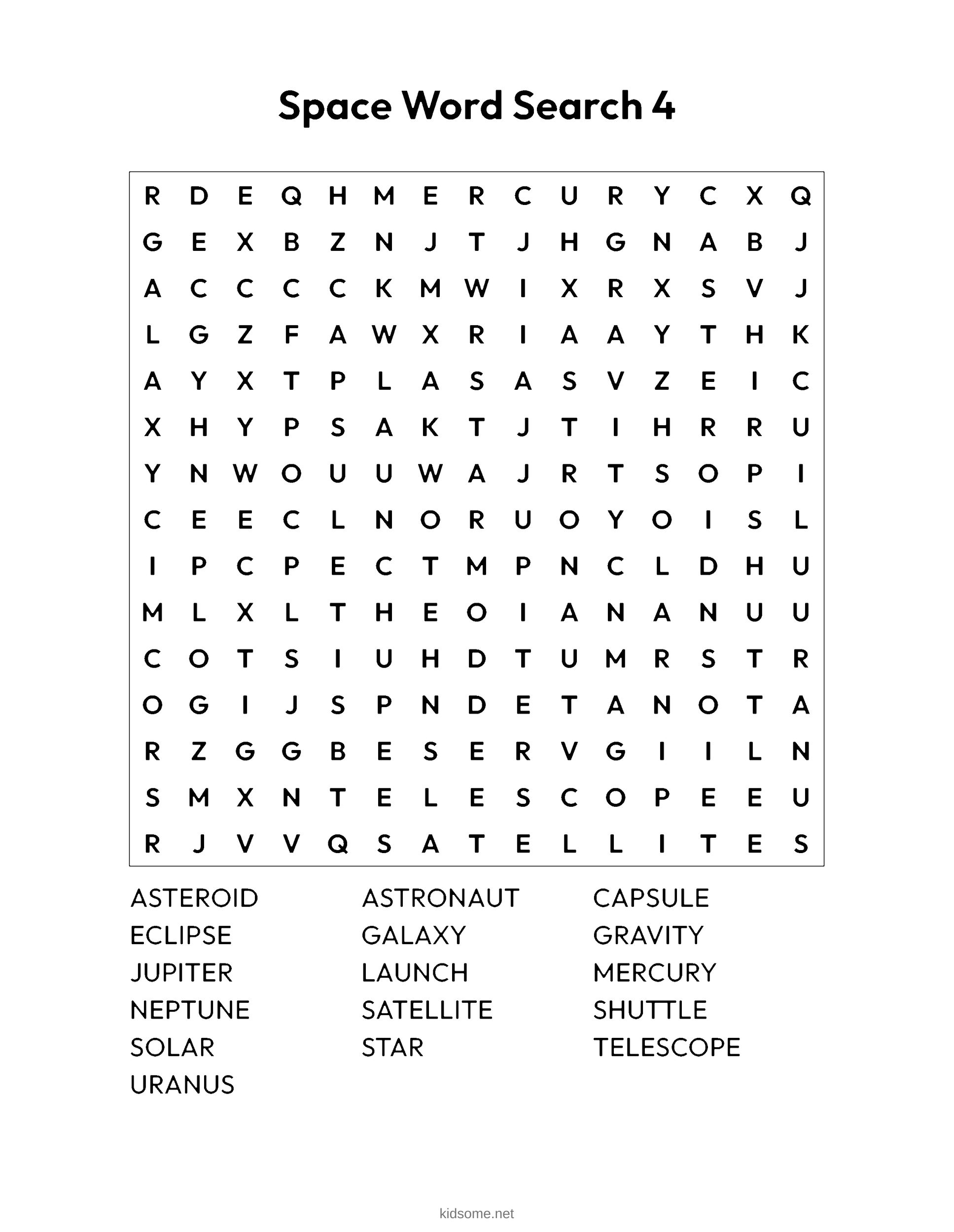 Save
Neptune and Eclipse on the Slant
A 15 by 15 grid with sixteen words, where Neptune and eclipse run on the diagonal and the long words astronaut, telescope and satellite stretch across or down.
Download PDFWord List: ASTEROID, ASTRONAUT, CAPSULE, ECLIPSE, GALAXY, GRAVITY, JUPITER, LAUNCH, MERCURY, NEPTUNE, SATELLITE, SHUTTLE, SOLAR, STAR, TELESCOPE, URANUS
Reveal Word List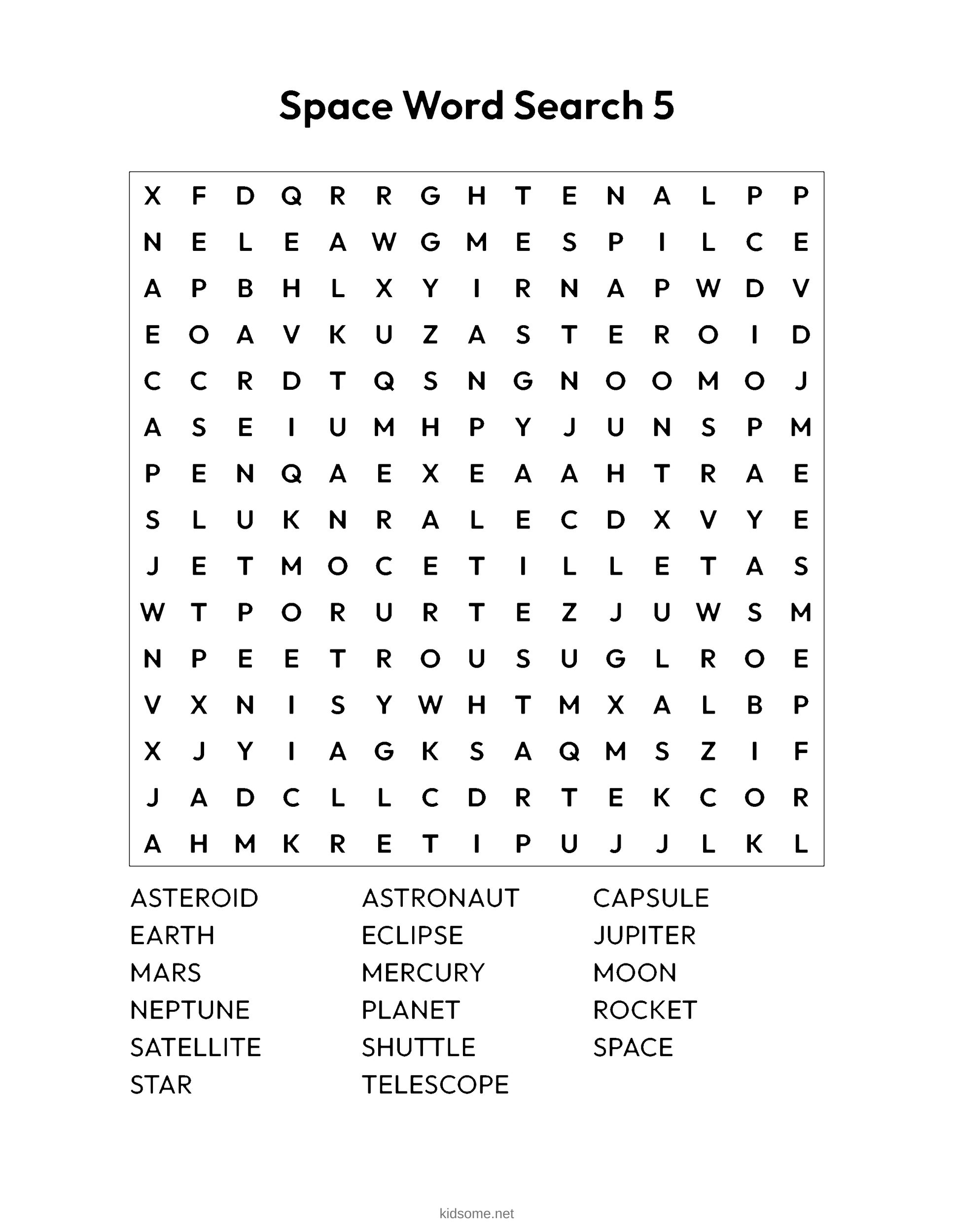 Save
Backward Rocket and Jupiter Search
A 15 by 15 grid with seventeen words where rocket, Jupiter and Earth read right to left, telescope and shuttle read bottom to top, and Mars climbs a diagonal.
Download PDFWord List: ASTEROID, ASTRONAUT, CAPSULE, EARTH, ECLIPSE, JUPITER, MARS, MERCURY, MOON, NEPTUNE, PLANET, ROCKET, SATELLITE, SHUTTLE, SPACE, STAR, TELESCOPE
Reveal Word List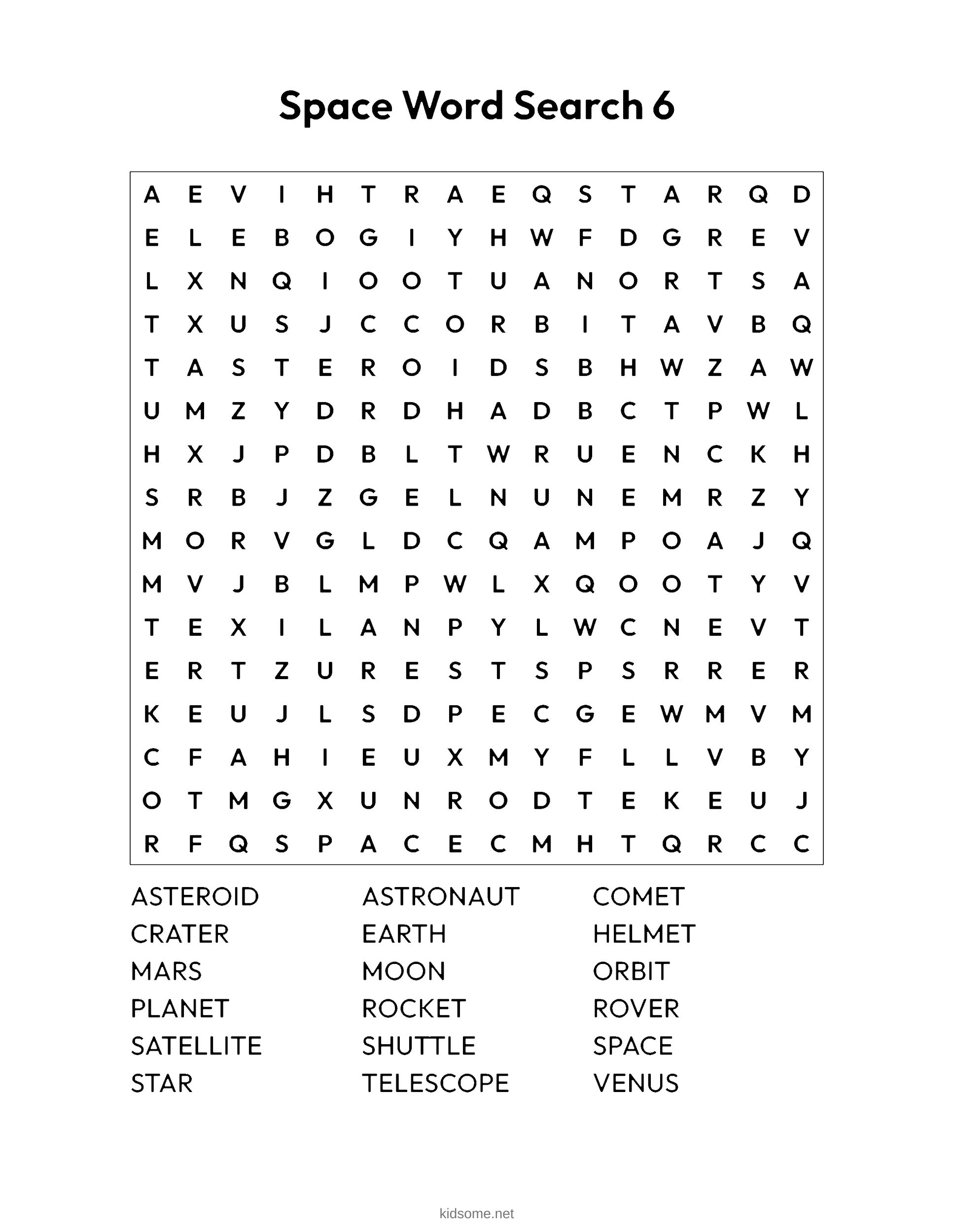 Save
Hardest Satellite and Helmet Grid
The hardest page, a 16 by 16 grid with eighteen words hidden forward, backward, up, down and on the diagonal, including satellite, helmet, planet and astronaut.
Download PDFWord List: ASTEROID, ASTRONAUT, COMET, CRATER, EARTH, HELMET, MARS, MOON, ORBIT, PLANET, ROCKET, ROVER, SATELLITE, SHUTTLE, SPACE, STAR, TELESCOPE, VENUS
Reveal Word ListHow to use these puzzles
Each PDF has two pages. Page one is the puzzle, and page two is the answer key, with every word circled in the same grid. To keep the answers hidden, choose page 1 only in your print settings and print a single key for yourself. Print at 100 percent or pick Fit to page. The PDF is set to US Letter, and the margins leave room for A4, so the grid and the word list print whole on either paper.
Plain copy paper is fine for pencils and colored pencils. Highlighters and markers can show through thin paper, so use cardstock if your child likes to shade each word in a bright color. For a sheet a whole class can share, slide it into a clear plastic sleeve, mark the words with a dry-erase marker and wipe it clean for the next student.
Easy Star and Moon Search and Comet and Crater Search are the easiest pages, with words that only run across or down, though a few words on the second page cross and share a letter. Gravity and Meteor Diagonal Search brings in three slanted words, and Neptune and Eclipse on the Slant adds astronaut, telescope and satellite. Backward Rocket and Jupiter Search turns most of its words around, and Hardest Satellite and Helmet Grid mixes every direction in the biggest grid.
One trick helps with long words: find a letter that is rare in the grid, such as the J in Jupiter or the Y in gravity, then check the eight squares around it. A ruler under each row keeps eyes on track, and crossing words off the list shows how many are left. Younger brothers and sisters can try the winter word search, which has smaller grids and shorter words.
Ideas for these puzzles
- Unit warm-up: Hand out Easy Star and Moon Search on the first day of a solar system unit. As students find each word, have them sort it: planets, things in the sky, or machines people built.
- Planet order: After a planet puzzle, have kids write all eight in order from the Sun: Mercury, Venus, Earth, Mars, Jupiter, Saturn, Uranus and Neptune. A silly sentence made from the first letters helps the order stick.
- Word cards: Pick five words from a list, such as orbit, gravity, crater, eclipse and comet, and have students write a short meaning for each on an index card. Keep them for review before a test.
- Beat the clock: Older kids can time themselves on Backward Rocket and Jupiter Search, then try a fresh copy a week later to beat it. Post the times on a chart by the classroom door.
- Partner search: Pair two students on one copy of Hardest Satellite and Helmet Grid. One reads a word aloud, the other hunts for it, and they swap after every word. Talking through the backward words builds good search habits.
- Night sky walk: On a clear evening, step outside after a puzzle and look for the Moon and the brightest stars. Talk about which words on the list you can see yourself and which need a telescope.
- Make your own grid: Give kids squared paper and have them build a small puzzle with eight space words for a friend. Hiding one word backward and one on the diagonal makes it feel like the harder pages.
- Early finisher folder: Keep copies of all six puzzles in a folder for early finishers and substitute days. Students choose their own level, and the answer keys stay in the teacher's desk until the work is checked.
- Puzzle stations: Set up three tables for an afternoon of word work: a space search, a vocabulary card table and the winter crossword puzzle. Groups rotate every fifteen minutes and try all three in one class period.
- Travel bag: Tuck a few puzzles, a pencil and a clipboard into a bag for car trips, waiting rooms and rainy afternoons. When the space set is done, the winter word scramble makes a quick change of pace.
What age is this space word search for kids?
The set is made for ages 8 to 12, the upper elementary years when most schools teach the solar system. Newer readers do best on the first two pages, where every word runs across or down. Strong readers and puzzle fans usually head straight for the last two grids, where words run backward, upward and on the diagonal and take more patient looking.
Where is the answer key?
Every PDF has two pages. Page one is the puzzle, and page two shows the same grid with each word circled, so you can check a finished sheet at a glance. To keep the answers private, print page one only for each student and keep one copy of the key at your desk, in a folder or on the fridge at home.
Does this planets word search have all eight planets?
Yes, across the set. Mercury, Venus, Earth, Mars, Jupiter, Saturn, Uranus and Neptune all appear, and Gravity and Meteor Diagonal Search has five of them on one page. The lists also cover the Moon, comets, meteors and craters, plus the rockets, rovers and satellites people send out, so it works as a solar system word search for a whole unit.
Will these puzzles print on A4 paper?
Yes. The PDFs are set to US Letter, and the margins are wide enough that each page prints in full on A4 as well. Leave scaling at 100 percent or choose Fit to page, and check the preview before you print. For a younger child at home, the dog word search prints the same way and has smaller grids.
Can I use these puzzles in my classroom?
Yes. Teachers, homeschool parents and tutors can print as many copies as their own students need. The puzzles are free for personal and classroom use. Please do not sell them, add them to a paid bundle or upload the PDF files to another website. Sharing a link to this page with other teachers on your grade team is always welcome.
Make your own: Free Word Search Generator for Kids