
Free Printable 120 Chart
Print a free 120 chart, the number chart first graders use to count past 100, from the ready-made charts below, or download it as a PDF. Customize your own 1 to 120 chart, click squares on it to hide their numbers, and print it with the answer key.
Ready-made 120 charts
-
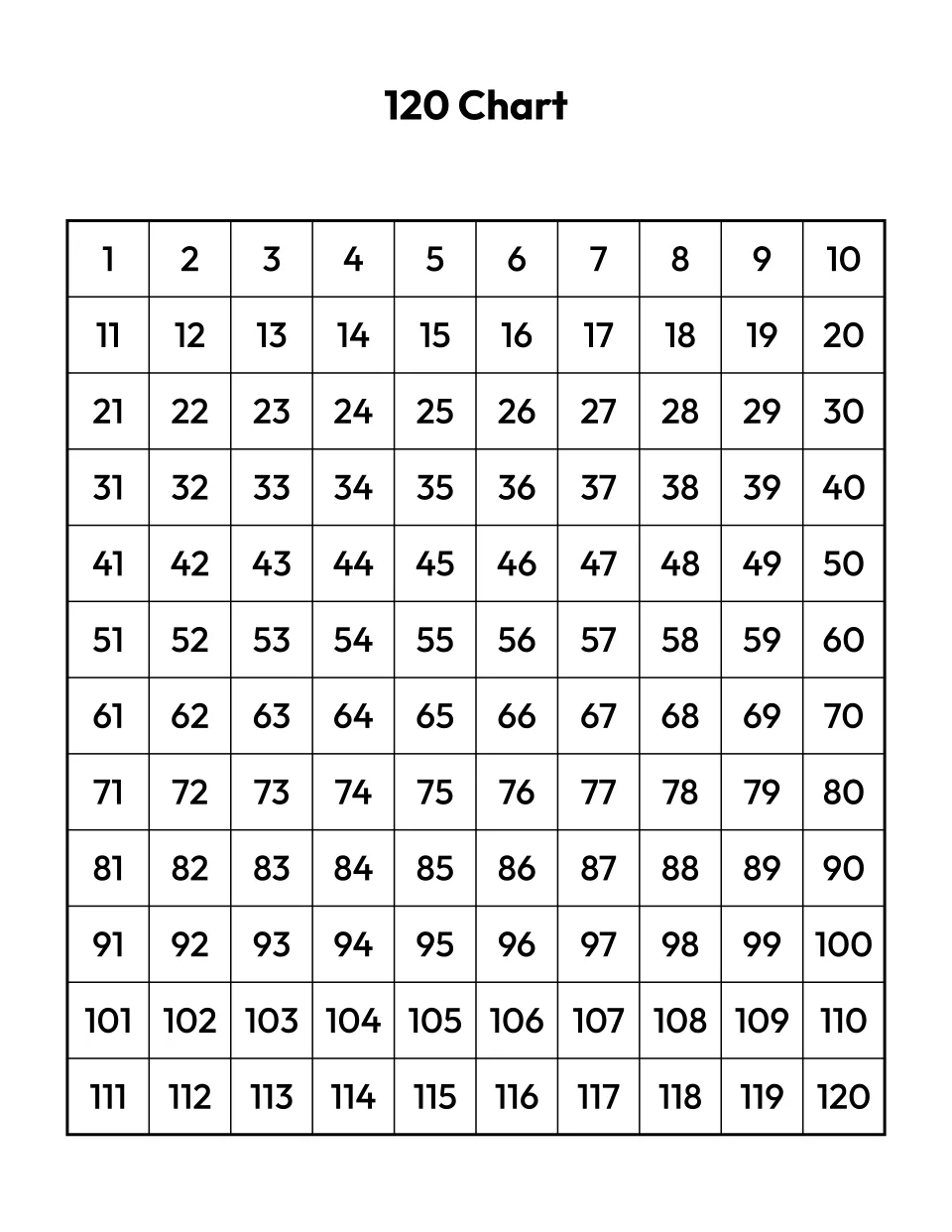
1-120
Customize the 120 chart 1-120, filled in -
Blank
Customize the blank 120 chart -
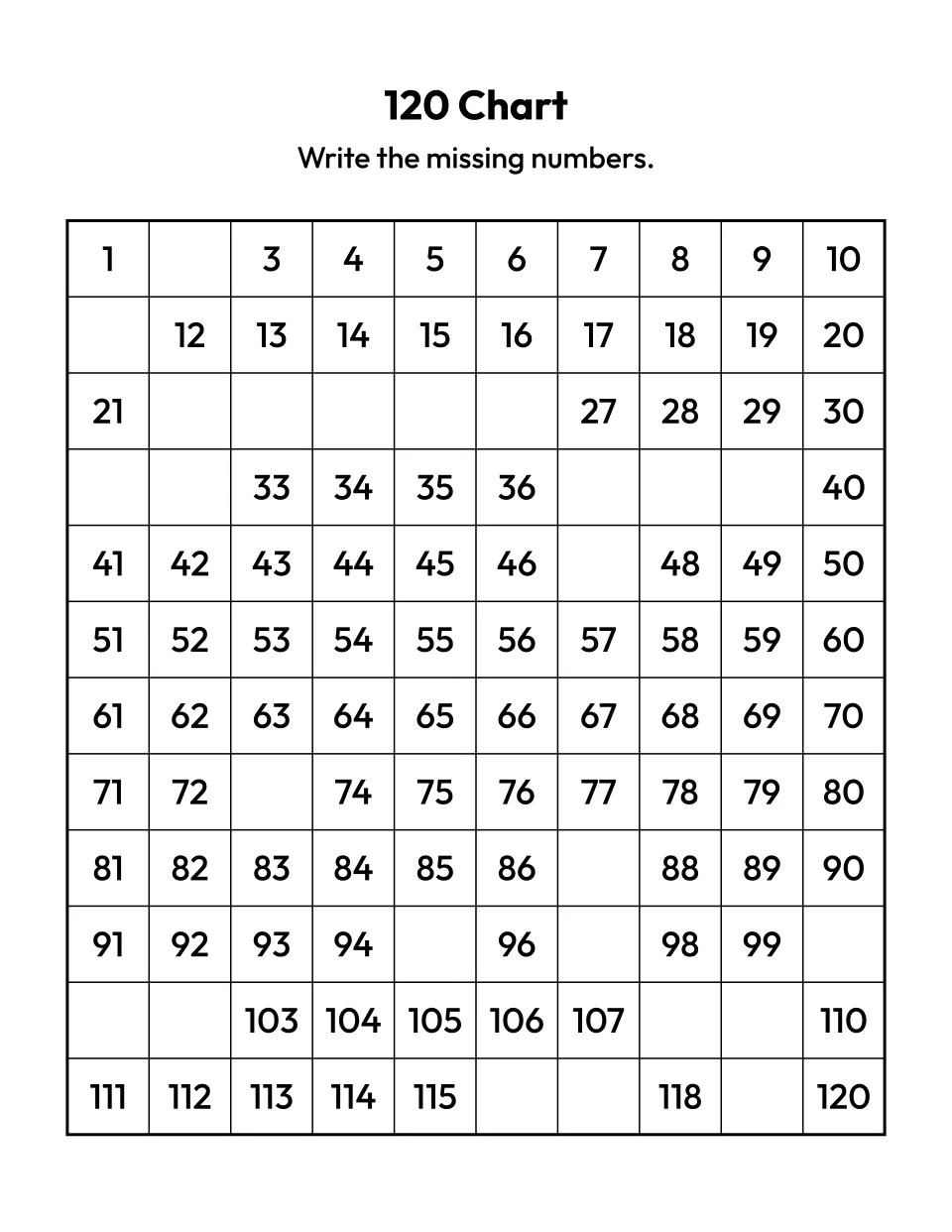
Missing numbers
Customize the 120 chart with missing numbers and answer key -
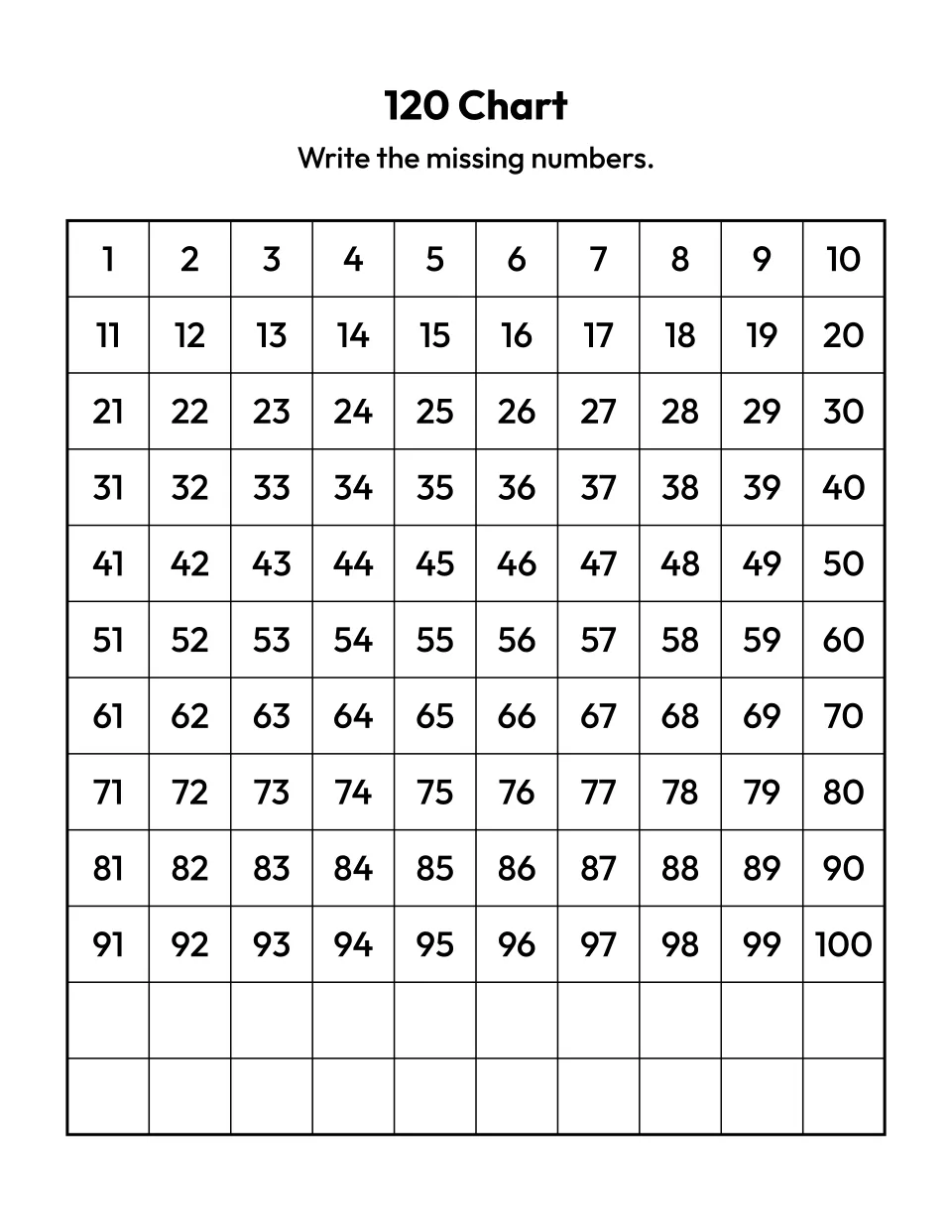
101 to 120
Customize the 120 chart with 101 to 120 to fill in and answer key -
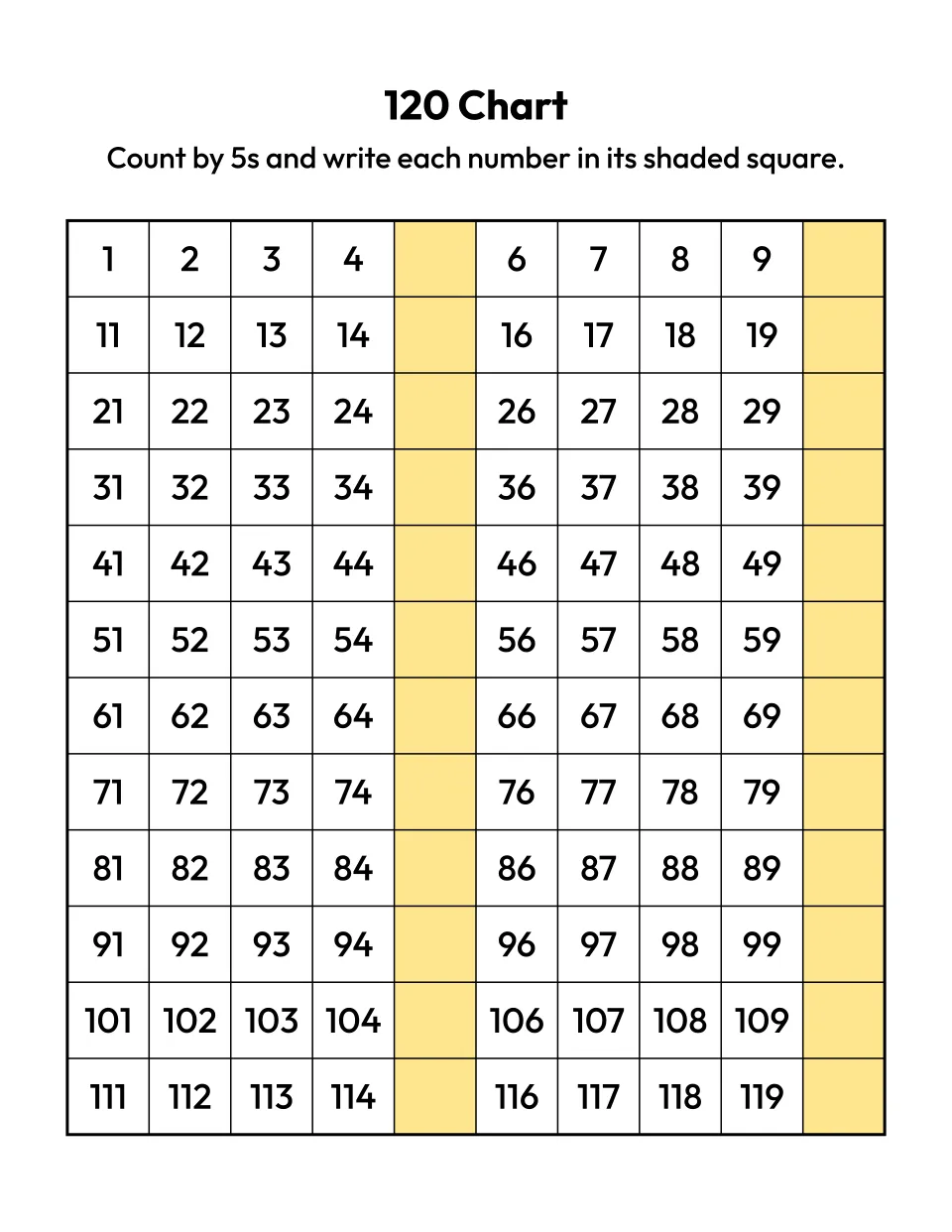
Count by 5s
Customize the skip counting by 5s on a 120 chart, with answer key
What is a 120 chart?
A 120 chart, or 120s chart, is a hundreds chart with two more rows: the numbers 1 to 120 in twelve rows of ten. First graders use it because their counting goes past 100. The Common Core standard 1.NBT.A.1 asks them to count to 120, starting at any number less than 120, and to read and write those numbers.
Customize your own
How to make your own 120 chart
Under Customize your own, the chart opens on 1 to 120. Choose what the cells show, or click squares on the chart to hide those numbers. Add a title and a number to count by if you want them, then press Print or PDF. Sheets with missing numbers put the answer key on page 2.
Choosing a chart through the year
| When | Cells | The child |
|---|---|---|
| Start of first grade | All numbers | Reads, points and counts on past 100 |
| Later in first grade | Some missing: 10, then 25 | Writes the numbers you leave out |
| End of first grade | Blank | Writes 1 to 120 in order |
| Second grade | Count-by numbers missing | Writes 5, 10, 15 and on, or 10, 20, 30 |
Missing-number and count-by sheets come with an answer key. Skip counting by 5s and 10s is a second grade goal in 2.NBT.A.2, and counting by 10s on a 120 chart ends at 120 in the last column. The count-by squares are shaded pale yellow, or circled for a black and white printer.
What you get
The chart fills one page in twelve rows, under your title and one line telling the child what to do. Squares are about 15 mm across, and the numbers print nearly 5 mm tall, on US Letter or A4. When numbers are missing, page 2 is the answer key: the full chart with the numbers to write in shown in bold. A filled or blank chart prints on one page. For a class, Add a version makes up to six charts, lettered A to F, each with settings of its own.
Tips for using a 120 chart
- Read the last two rows aloud. 101 to 120 follow the pattern of 1 to 20, which helps children read numbers with three digits.
- Find 10 more and 10 less. One row down is 10 more and one row up is 10 less, the mental math in 1.NBT.C.5.
- Start anywhere. Point at 87 and count on to 120 from there, as 1.NBT.A.1 asks.
- Count by 10s past 100. Shade the 10s and the last column reads 10, 20 and on up to 120.
More math printables
Teaching kindergarten? The 100 chart page makes 1 to 100 and 0 to 99 charts. Counting by 2s, 5s and 10s leads into the times tables, and the printable multiplication chart page prints them as a chart with an answer key. Practice writing numbers with our printable tracing sheets, or try sudoku for kids. The word search generator and more makers are on our free printable makers page.
Questions about the 120 chart
Is this 120 chart free to print?
Yes. The ready-made charts above and any chart you make are free, with no sign up and no limit on how many you print. Each chart is drawn in your browser, and nothing you type is uploaded or stored. Print as many copies as your class needs: the charts are free for personal and classroom use, including homeschool groups. The PDF carries only a small line with our site name at the bottom of the page.
How do you use a 120 chart?
Point to a number and count on from it, by ones or by tens. Moving one square to the right adds 1, and moving one row down adds 10, so a child can find 47 plus 10 by dropping one row to 57. First graders also use the chart to read and write numbers past 100 and to fill in missing numbers in a row.
Is there a 120 chart with missing numbers?
Yes. Press PDF or Print under Missing numbers in the ready-made charts above for a chart with 25 of the 120 numbers left out and the answer key on page 2. The 101 to 120 chart leaves out the last two rows, the numbers past 100. To set how many are missing, choose Some missing under Customize your own, or click the squares you want left out.
Why do first graders use a 120 chart instead of a 100 chart?
First grade counting goes past 100. The Common Core standard 1.NBT.A.1 asks children to count to 120, starting at any number less than 120, and to read and write those numbers. A 100 chart stops just as that harder part starts. The two extra rows show that 101 to 120 follow the same pattern as 1 to 20, one hundred higher.
Can I print a blank 120 chart?
Yes. Press PDF or Print under Blank in the ready-made charts above for an empty grid of 120 squares in twelve rows. Children write the numbers in order, which is good practice for writing numbers past 100. A blank chart has no answer key, so print the filled 1-120 chart to check against. To shade every 10th square as a guide, pick 10s under Count by in Customize your own.
Can I make a chart that goes past 120?
Not here. 120 is the count first graders work toward, and twelve rows of ten is the most that fits one page with numbers nearly 5 mm tall and squares wide enough to write in. A 150 or 200 chart would need smaller squares or a second page. For a smaller chart, the Numbers setting under Customize your own also makes 1 to 100 or 0 to 99.
Can I print a 120 chart from a phone, or on A4 paper?
Yes. Tap PDF under any chart to save it to your phone or tablet, or Print to send it to a wireless printer. If your printer takes A4, choose A4 under Paper in Customize your own, and both the ready-made charts and your own print on A4 instead of US Letter. Once you change a setting, the page address holds it, so a saved link prints the same chart the next time.