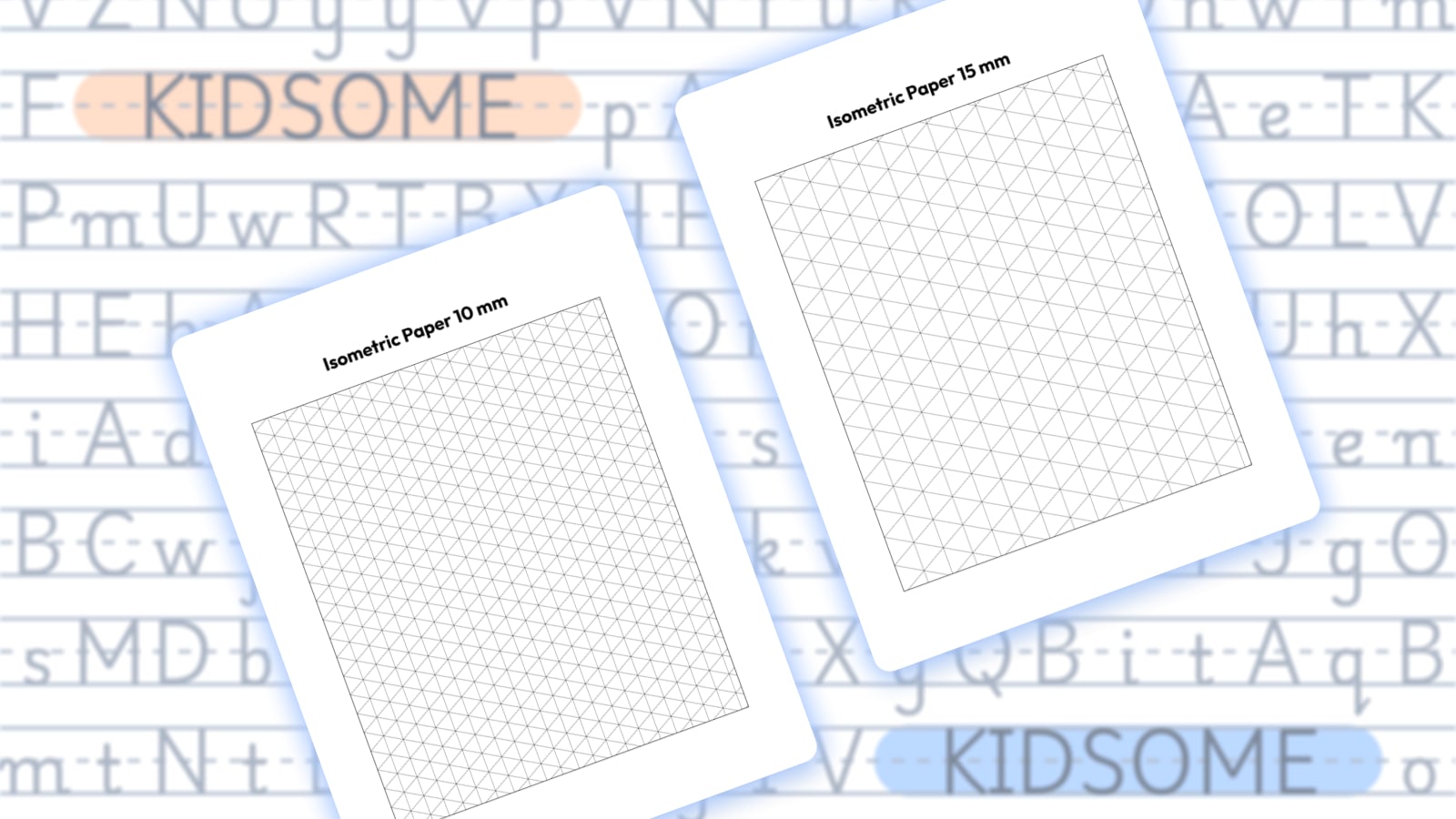
This isometric graph paper set helps older kids draw solid looking 3D shapes without guessing at angles. Instead of squares, the page is covered in a grid of small triangles, with lines running straight up and down and on two slants. Follow those lines and a cube, a staircase or a whole block city pops off the page, every edge at the right angle.
There are two free PDFs. Isometric Paper 10 mm has a finer grid for detailed builds, tall towers and careful geometry. Isometric Paper 15 mm uses bigger triangles, so it is the friendlier start for beginners and anyone who wants to color in the faces of each shape. Each page has a title and a simple border, and both print on US Letter and A4 with nothing to sign up for.
The set suits ages 8 to 12 at home, in art club or in a math lesson on solids and volume. When a task needs plain squares, our graph paper sits on the same shelf.
More free packs, from writing lines to grids, are on the printable paper page.
Download the isometric paper
 Save
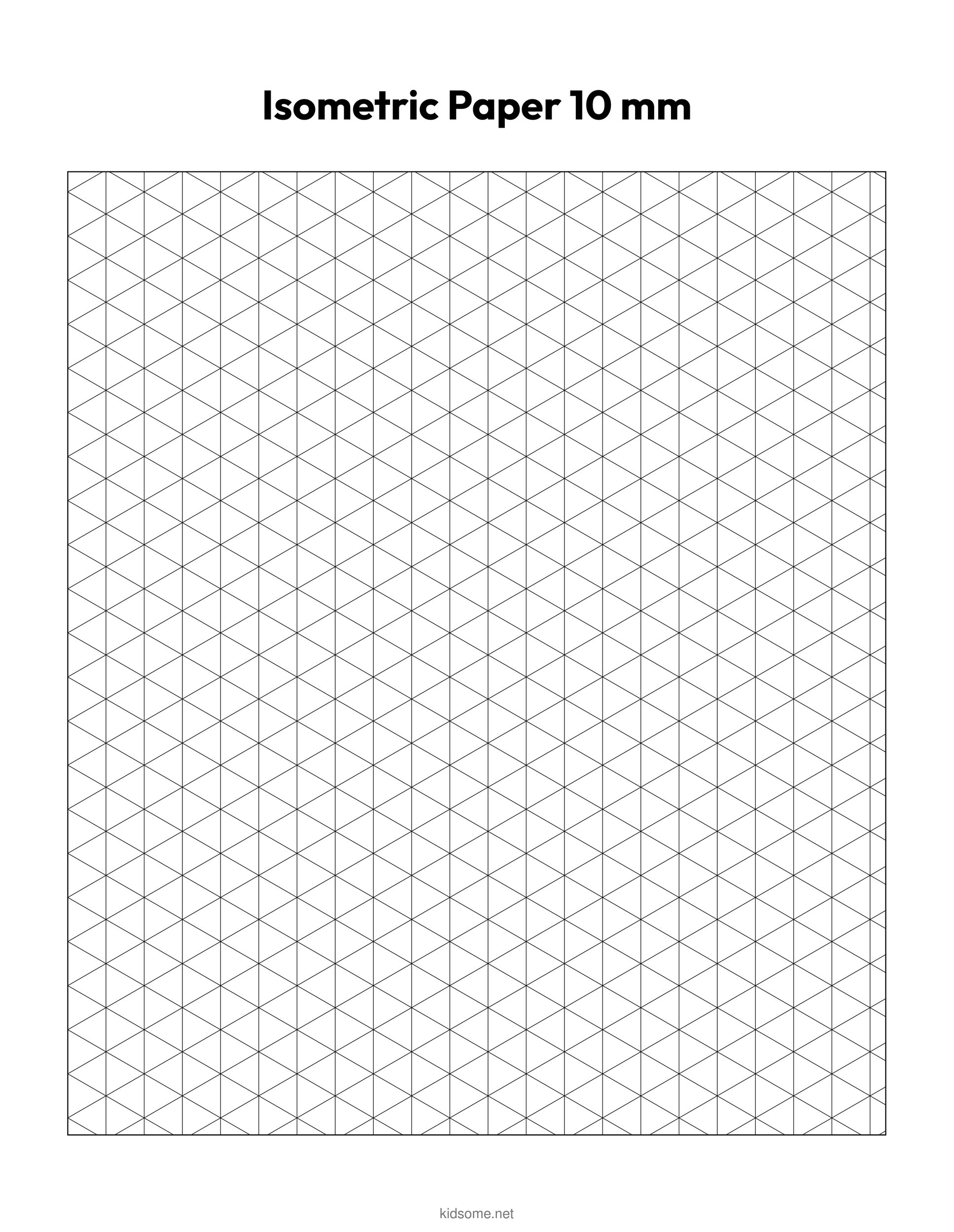
Isometric Paper 10 mm
A full page of small triangles on a 10 mm isometric grid inside a simple border, best for detailed 3D buildings, block models and geometry practice.
Download PDF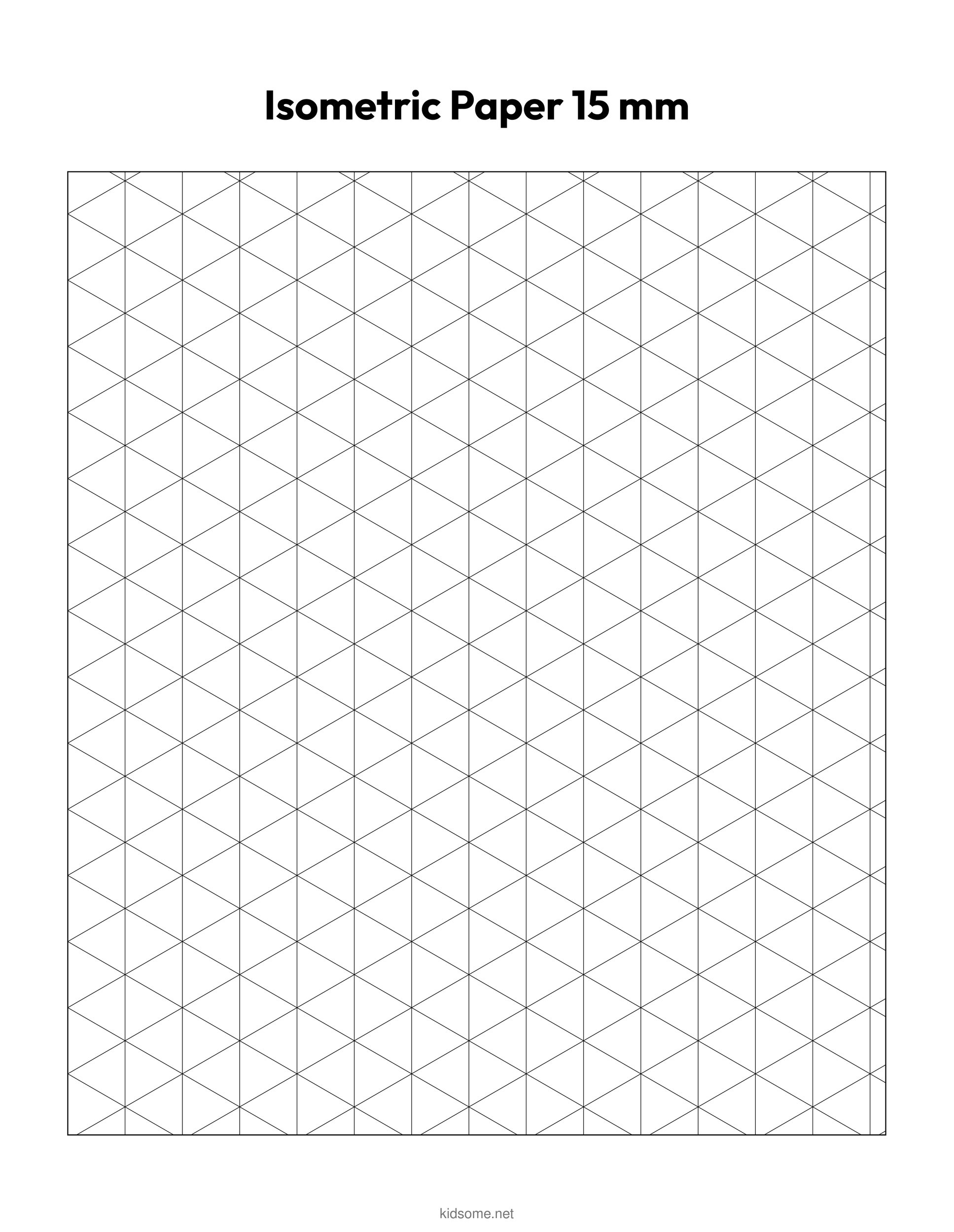 Save
Isometric Paper 15 mm
A full page of larger triangles on a 15 mm isometric grid inside a simple border, a friendly first page for drawing cubes, stairs and simple 3D shapes.
Download PDFHow to use this paper
Print at 100 percent, or choose Actual size, so the triangles keep their true spacing. Fit to page works if your printer trims the edges, though the grid shrinks slightly. Each PDF is set up for US Letter with margins that also fit A4. Copy paper is fine for pencil sketches; card stock is better for markers or for nets that will be cut out and folded.
Start with Isometric Paper 15 mm. The larger triangles make it easy to see the three directions of the grid and to count units along each edge. Once a child can draw a neat cube there, move to Isometric Paper 10 mm for bigger scenes, more detail and harder block models.
Show the basic cube first. Pick a point where lines cross, draw one vertical edge two units tall, then follow the two slanted lines out from its top and bottom to finish the sides. Close the top with lines parallel to the slants. Every other shape on isometric drawing paper is built the same way, one cube or one edge at a time.
Draw lightly in pencil until the shape looks right, then go over the edges you want to keep with a fine pen. Shade the top, left and right faces in three different tones so the shape reads as solid. A ruler helps on long edges, but many kids find the grid alone keeps lines straight.
Ideas for using this paper
- Block city: Draw a row of buildings from cubes stacked to different heights on Isometric Paper 10 mm. Add windows, doors and rooftop gardens, then shade each face so the city looks solid.
- Count the cubes: Teachers draw a stack on Isometric Paper 15 mm and ask how many cubes it holds, including hidden ones. Students then build it with snap cubes to check their answer.
- Copy a model: Build a small shape from building bricks or snap cubes, set it on the table and draw it on the grid. Turn it around and draw it again from the new side.
- Letters in 3D: Write a name or initials as chunky block letters that follow the grid lines. Color the top faces light, the sides darker, and hang the finished name on a door.
- Optical puzzles: Draw a staircase or a cube pattern that seems to flip as you look at it. Talk about why the eye reads the same lines in two ways.
- Room design: Plan a dream bedroom as an isometric box with the front walls left open. Add a bed, desk and shelves, keeping each piece lined up with the grid.
- Volume lesson: Give students a volume such as twelve cubes and ask for three different shapes that use exactly that many. Compare the drawings and discuss which shape has the most visible faces.
- Rocket model: After the steps in how to draw a rocket, redraw the rocket as a blocky 3D model on the larger grid, with fins and a launch pad.
- Game level sketch: Design a maze of platforms, ramps and stairs in 3D. Mark a start and a finish, then let a friend trace the path with a finger.
What is isometric graph paper?
Isometric graph paper is a grid of triangles instead of squares. Its lines run vertically and at two matching slants, so the three edges of a cube can follow the grid exactly. That lets kids and adults draw 3D objects that look solid and stay in proportion. Some people call the same page isometric grid paper or isometric paper.
Which grid size should a beginner use?
Isometric Paper 15 mm is the easier start because the bigger triangles make each line clear and leave room to color faces. Isometric Paper 10 mm fits more on one page, so it suits detailed buildings, larger block models and older students. For ages 8 to 12, most kids enjoy starting large and moving to the finer grid later.
Will this isometric paper printable work on A4 and US Letter?
Yes. Each PDF is set up for US Letter and also fits A4. Print at 100 percent or Actual size to keep the triangles at their true spacing. Fit to page is fine if the printer cuts off an edge, though the grid will shrink a little. The lines are thin and gray enough to sit behind a drawing.
Can teachers copy these pages for a class?
Yes. Teachers, tutors and parents can print as many copies as they need for personal and classroom use, free with no sign-up. Please do not sell the pages, add them to a paid bundle or upload the files elsewhere. A link to this page is the best way to share it with other teachers or families.
What tools work best for isometric drawing?
Start with a sharp pencil and a good eraser, since early cubes often need a fix. A ruler helps on long edges. Once the shape is right, trace it with a fine liner and erase the pencil. Colored pencils in three tones of one color make the top and sides of each shape stand out.